
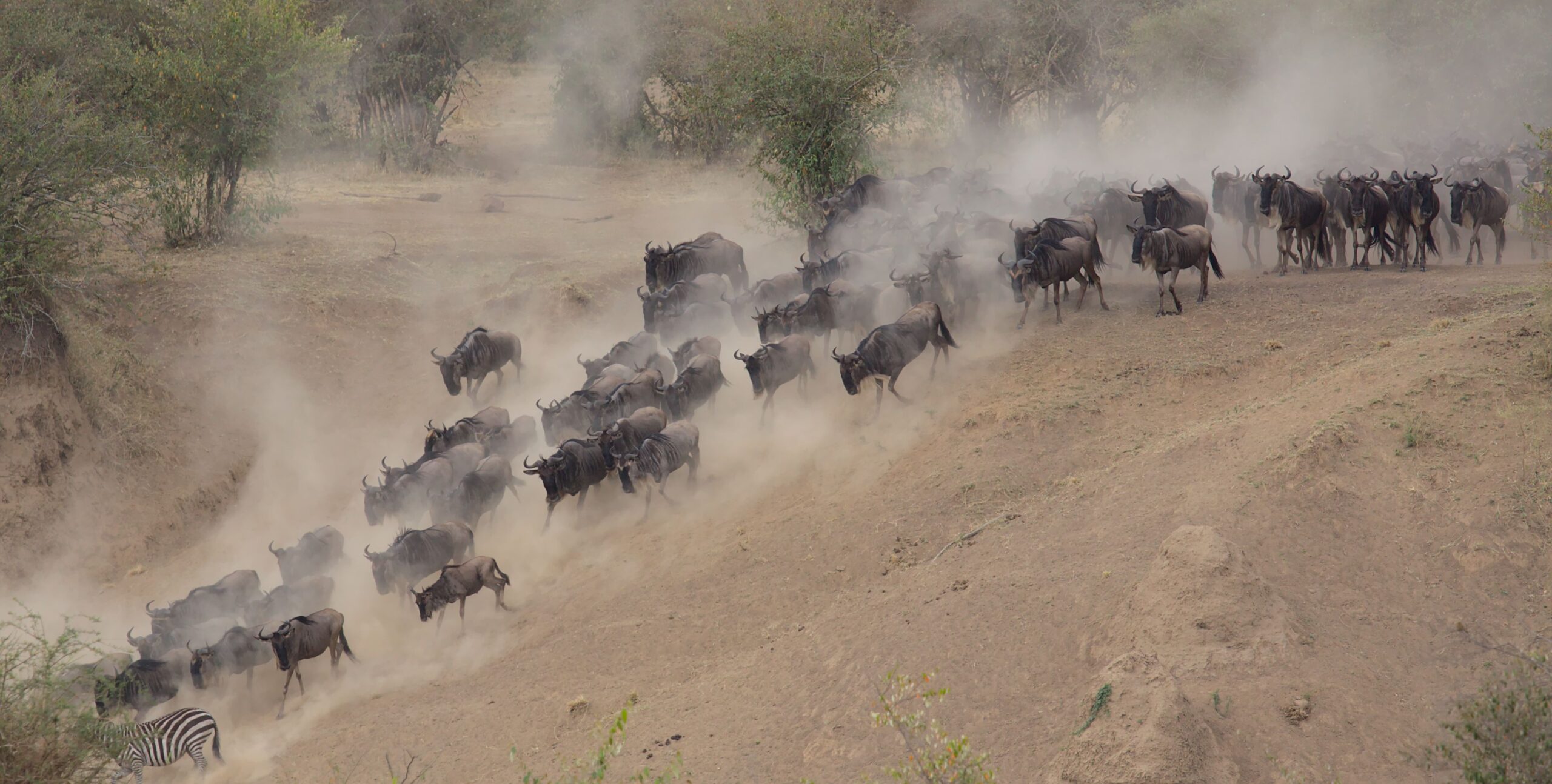
Standing on the Serengeti plains while a column of wildebeest stretches to the horizon is one of those travel moments you never forget. The Great Migration is not a single event on a calendar — it is a year-round cycle of rain, grass, predators, and movement across Tanzania and Kenya. If your dream safari includes river crossings, newborn calves on golden grass, or lions stalking herds at dusk, timing your visit correctly is everything.
Our team is based in Arusha, at the gateway to the northern circuit. We plan Serengeti migration safaris every month of the year, and the question we hear most often is simple: when should I come? This guide answers that with a month-by-month breakdown, practical planning tips, and honest advice on how many days you need.
The Great Migration involves more than a million wildebeest, hundreds of thousands of zebra, and smaller numbers of gazelle moving in search of fresh grazing and water. The cycle is driven by seasonal rainfall across the Serengeti-Mara ecosystem — not by a fixed timetable. Herds drift between Tanzania’s Serengeti National Park and Kenya’s Masai Mara, following the rains in a loop that has repeated for millennia.
Predators do not take holidays. Lion, cheetah, leopard, hyena, and crocodile all key into the herds’ movements. That is why migration season delivers some of Africa’s most dramatic wildlife viewing — particularly around river crossings where wildebeest must run a gauntlet of current, bank, and crocodile.
At the start of the year, herds concentrate on the nutrient-rich short-grass plains south and east of the Serengeti, including the Ndutu area adjoining Ngorongoro Conservation Area. This is calving season: thousands of wildebeest calves are born daily over a few weeks. The strategy is safety in numbers — but predators exploit the abundance of vulnerable young. Cheetah, lion, and hyena sightings can be exceptional.
Weather is warm with occasional short rains. Landscapes are green and photogenic. Crowds are moderate compared with peak dry season. If your priority is predator action and cute calves rather than river crossings, this is an outstanding window.
The long rains arrive. Grass grows tall, skies can be dramatic, and some remote tracks become challenging. Many travelers avoid this period, which means fewer vehicles on the plains and lower lodge rates. Herds begin drifting northwest as the southern plains dry out.
If you are flexible, don’t mind rain showers, and want value, April and May can still deliver excellent wildlife. Pack a light rain jacket and choose a operator with well-maintained 4×4 vehicles. Photography lovers often praise the moody light this time of year.
As the plains dry, columns of wildebeest and zebra push toward the western Serengeti and the Grumeti River region. June marks the start of peak interest for many travelers. Grass is still reasonably green in places, and the atmosphere builds toward the northern push.
Grumeti River crossings can occur in June depending on local conditions — though they are generally less famous than the Mara crossings later in the year. Combining western Serengeti with Ngorongoro and Tarangire on a single itinerary works well this month.
Herds funnel toward the northern Serengeti and the Mara River. This is the period most associated with iconic river-crossing footage — wildebeest plunging into water while crocodiles wait downstream. Exact crossing days cannot be guaranteed; they depend on rain, grass, and herd leaders’ decisions. Your guide uses scout networks and daily reconnaissance to maximise chances.
July and August are busy. Book lodges and private vehicles early. Expect dry, dusty conditions and cold mornings — especially on the crater rim if you include Ngorongoro. The trade-off is world-class predator viewing and the electric atmosphere of the northern plains.
Many operators consider September the sweet spot: herds are often still crossing the Mara River, weather is dry and predictable, and wildlife concentrates around remaining water sources. October can be equally strong as herds begin thinking about the return south, though crossings may taper depending on the year.
This is prime time for photographers with long lenses. Patience is essential — you may wait hours at a crossing point before thousands of animals commit. When they do, it is unforgettable.
Short rains refresh the landscape. Herds start moving back toward the southern Serengeti plains as the cycle prepares to repeat. Predator action remains strong, and visitor numbers drop compared with August and September. Travelers who want migration ecology without peak-season crowds often love November.
December combines holiday travel demand with green scenery and good general game viewing. If you are combining safari with Zanzibar beach time over the holidays, plan even further ahead.
If river crossings are your primary goal, target late July through October in the northern Serengeti. Crossings are never 100% predictable — nature does not follow flight schedules — but this window gives you the best statistical chance. A minimum of three full days in the northern Serengeti improves odds; more is better.
For calving season and intense predator action on young wildebeest, choose January through March in the Ndutu / southern Serengeti area. You are unlikely to see Mara-style crossings then, but the photography and cat action can rival anything on television.
We recommend at least 7 to 8 days on the ground for a focused Great Migration itinerary that also includes Ngorongoro Crater and Tarangire. Shorter trips are possible if you are already in Tanzania, but migration safaris benefit from flexibility — an extra day in the Serengeti lets your guide respond to herd reports without cutting crater or elephant country entirely.
Our 8-Day Great Migration Safari is built around this philosophy: enough time in the Serengeti for crossings or herd tracking, plus Ngorongoro and Tarangire for Big Five diversity. Browse all options on our Tanzania safaris page.
Accommodation strategy should follow the herds. In calving season, southern Serengeti and Ndutu mobile camps put you close to action. During northern crossings, permanent and seasonal lodges around Kogatende and the Mara River are the base most guides prefer. Mobile camps can reposition with the herds — excellent for enthusiasts willing to trade some luxury for location.
We match lodge level to your budget: comfortable mid-range lodges, classic tented camps, or higher-end properties with guided walks and private vehicles. Tell us your priorities when you request a quote and we will build accordingly.
A standard 7-day northern circuit safari covers Serengeti, Ngorongoro, Tarangire, and Manyara with a balanced route ideal for first-time visitors. A migration-focused trip tilts Serengeti time toward seasonal herd locations — sometimes at the expense of a rigid day-by-day schedule. Both deliver incredible wildlife; migration safaris require more date-specific planning.
Crossings are unpredictable. Wildebeest hesitate at the bank for hours or days, then surge in minutes. Guides share radio reports, but nature sets the schedule. July through September in the northern Serengeti and Mara sector offers the best odds — not a guarantee. Build at least three Serengeti days into your itinerary if crossings are your priority.
Book mobile camps near likely crossing points in peak months, or choose permanent lodges with reasonable drive distance. Our safari packages align camp zones with season; tell us if crossings are your main goal when you book.
Hundreds of thousands of wildebeest give birth on short-grass plains near Ndutu. Predators exploit the abundance — cheetah, lion, and hyena action is intense. Skies can build dramatic storms; roads may be muddy but passable. Fewer tourists than mid-year north, and excellent for photographers who want birth and chase sequences rather than Mara crossings.
May and June often see herds pushing through the western corridor toward Grumeti River crossings — crocodile action with smaller crowds than the Mara. Lodges here are more exclusive and priced accordingly. Good choice if you want migration flavor without peak-July congestion.
Peak migration months command premium lodge rates and charter flights. Mobile camps cost more than some mid-range lodges but place you on the herds. Private vehicles add flexibility worth the spend during crowded northern season. Shoulder weeks at the start or end of a corridor window can save 15–25% with similar wildlife.
Pair timing with our 7-day northern circuit guide for park flow and packing list for seasonal clothing — green season vs dry season changes what you bring as much as what you see.
Mobile camps follow herds with luxury tented setups — canvas, proper beds, bucket showers — repositioned by crew. You wake closer to action but sacrifice pools and some fixed amenities. Permanent lodges offer pools, spas, and sturdier buildings; you may drive farther each morning. Neither is “better” — match style to your comfort and photography goals.
Resident Serengeti lions, leopards, and elephants reward travelers in any month. The Great Migration adds scale — miles of moving wildebeest, dust columns visible from kilometers away, and predator concentrations that spike when calves are born or river crossings fail. If your dream is specifically crossings or calving, dates and camp zone matter more than for a classic first safari that simply wants the Big Five.
July through September lodges in northern Serengeti often sell out six to twelve months ahead. January through March calving near Ndutu fills early for photographers. Last-minute trips are possible but with fewer camp choices and higher airfare. Share your fixed leave dates when you request a quote — we hold provisional space while you confirm flights.
The Mara River ecosystem spans Tanzania and Kenya. Crossings happen on both sides depending on grass and rain. Tanzania offers larger public plains and pairs naturally with Tarangire and Ngorongoro on a 7-day northern circuit. Kenya’s Masai Mara is smaller and busier but famous for dramatic August scenes. Many guests choose Tanzania for space, value, and circuit variety.
Dust, long mornings, and temperature swings define migration travel. Neutral layers, telephoto lenses, spare batteries, and a buff for vehicle dust are essentials — see the full Tanzania safari packing list. Green-season calving adds mud-capable footwear and rain shells; dry-season crossings add extra lens cloths and allergy meds if you are dust-sensitive.
Minimum three full days in the right corridor for crossings or calving; two days feels rushed if herds move overnight. Pair with Tarangire and Ngorongoro on a week-long northern circuit rather than flying in for a single park — context and variety make the migration moment hit harder when it finally happens.
Wildebeest follow rain and fresh grass, not calendar posters. A late start to short rains can delay northward movement; early storms pull herds off expected corridors. Guides and mobile camps adapt daily — fixed predictions months out are estimates, not promises. Flexibility in lodge zone and patience at river banks separate satisfied guests from disappointed ones who expected a crossing on command.
Combine realistic expectations with expert positioning: read our month-by-month sections above, pack for dust and dawn cold using the safari packing list, and book enough Serengeti nights that herds have time to find you.
Questions about your exact month? Tell us your travel dates when you enquire — we map herd corridors to your itinerary and recommend how many Serengeti nights you need.
August and September are the peak months for Mara River crossings in the northern Serengeti. January to March is best for calving season in the southern plains near Ndutu.
We recommend at least 7 to 8 days so your guide can follow herd movements between Serengeti, Ngorongoro, and Tarangire without rushing.
The herds move in a continuous loop across the Serengeti-Mara ecosystem, including Kenya Masai Mara. Most Tanzania-focused safaris stay within Serengeti and surrounding parks.
River crossings are seasonal and depend on rainfall. They are most predictable around the Grumeti and Mara rivers from June through October, but nature sets the exact timing.
Calving season is when hundreds of thousands of wildebeest give birth on the southern Serengeti plains, usually January through March. Predator action is intense.
Yes. July is when herds often push north toward the western corridor and Grumeti River. Lodges fill early, so book well in advance.
A private 4×4 with an experienced guide gives you flexibility to reposition when scouts report crossings or fresh herds — especially valuable in peak season.
A migration-focused trip prioritizes herd locations and river crossing zones by season. A standard safari still delivers excellent wildlife but follows a broader northern circuit route.
Neutral layers, a warm jacket for dawn drives, binoculars, and a zoom lens. June to October is dry season — dust masks and lip balm help on long game drives.
For July through October, book 6 to 12 months ahead. Calving season (January–March) is slightly easier but still benefits from early planning for best camps.
The Great Migration is the Serengeti at its most raw and spectacular — but the right dates and the right guide matter as much as the right lodge. Tell us your travel month, group size, and whether crossings or calving season is your priority. We reply within 24 hours with a tailored route and transparent pricing from our Arusha office.
Request your Great Migration safari quote or call us at +255 770 693 683.
[…] and what to leave at home. Pair it with our 7-day northern circuit guide for daily rhythm and our Great Migration calendar for seasonal weather. Ready to travel? Browse safari packages or book your […]
7-Day Northern Circuit Safari Guide | Tanzania Safari Trip
July 10, 2026[…] see our 7-Day Northern Circuit Safari package or request a custom quote. For seasonal timing, read when to see the Great Migration; for gear, use our Tanzania safari packing […]